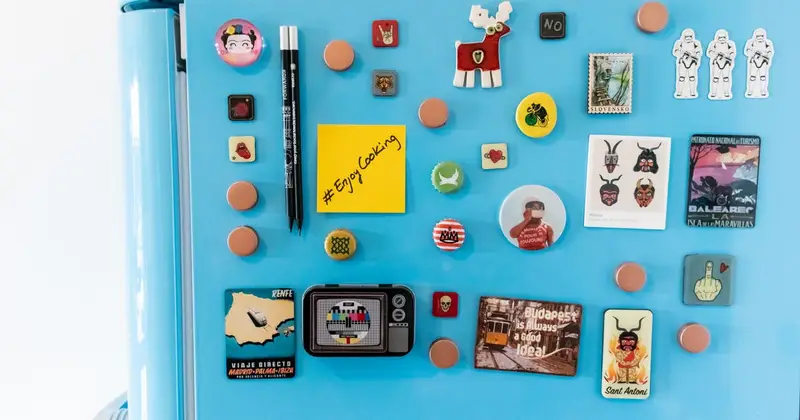
Pick a pattern before you start sticking
A refrigerator door either looks arranged or looks accumulated, and the difference is almost never the photographs. It is whether anyone chose a shape first. Photo fridge magnets get added one at a time, wherever there happens to be a gap, until the door resembles a noticeboard at a bus station. Below are five layouts that hold up in a real kitchen, followed by the physical constraints that decide which one you can actually use.
The grid: for a matching set
Three across and two down, even gaps, all the same size and shape. The grid is the most forgiving pattern because regularity does the work: even mediocre photographs look considered when they line up. It suits a set ordered together in one format, and it fails the moment you add a stray odd-sized piece. If you want to grow the display later, add a whole row rather than tucking extras into the margins.

The cluster: for an odd collection
Pieces accumulated over years rarely match, and forcing them into a grid highlights that. Cluster instead. Put the largest piece slightly off center, then arrange the rest around it with consistent narrow gaps, letting the outer edge stay irregular. The eye reads the group as one shape. The rule that makes this work is a single visual anchor: one clearly dominant piece, not three competing for the role.
The strip: one year, left to right
A single horizontal band at eye height, running chronologically. Six to eight pieces is the useful range. This is the only layout that carries a sequence, so it suits a school year, a pregnancy, a renovation, or a trip. It also has a practical advantage: when the year ends you lift the whole strip off at once and start again, which makes the annual refresh a two-minute job rather than a rearrangement.
The single hero: when there is one great photo
If one image is genuinely better than the rest, give it the door alone at eye level and put nothing within a hand's width. A lone photograph on a large blank surface reads as deliberate in a way that a dozen never will. This is the layout for a household that finds clutter stressful, and it is the easiest to maintain, because the only decision is which picture earns the spot this month.
The swap rail: a narrow band you change often
Reserve one narrow strip, perhaps the top of the freezer door, as the only place that changes. Everything else stays fixed. Because the rotating area is small and defined, swapping becomes a habit instead of a project, and the rest of the display keeps its composition. This is the layout that survives a busy household, since nobody has to redesign anything to add the newest photo.
Work around the handle, seam, and dispenser
The door is not a blank rectangle. There is a handle attracting hands and smudges, a seam between fridge and freezer that breaks any layout crossing it, and often a water dispenser removing a whole column. Map those first. Treat the seam as a frame edge rather than something to straddle, keep faces a few inches clear of the handle, and never place your best piece where the door swings against a wall.
When the door will not hold a magnet
Plenty of kitchens defeat this entirely. Integrated fridges have wooden or laminate fronts with no steel behind them, and some stainless finishes are non-magnetic alloys that reject even strong magnets. Test with any magnet before ordering. If the door fails, a steel memo board on the wall, the side panel of the fridge, the dishwasher front, or a range hood usually works, and the side panel is often better lit than the door anyway.
Sharing the surface with paperwork
Most doors already carry school letters, appointment cards, and a calendar. Rather than fighting for space, put every functional item on one side or on the freezer door and keep the photographs on the other. Split by side, not scattered. Paper is temporary and photographs are not, so mixing them means the display gets disturbed every time a permission slip arrives and never settles into a shape.
Rentals, dorms, and shared kitchens
In a shared or temporary kitchen, a big display is a social problem. Keep it to three or four pieces, use the side panel rather than the communal door front, and choose smaller sizes. Magnets are ideal in rentals precisely because they leave nothing behind: no holes, no adhesive residue, no argument at the end of a tenancy. The whole display peels off into an envelope on moving day.

Where to order photo fridge magnets
Once the layout is chosen and the door has been tested, shop photo fridge magnets to place the order. The photo magnets hub covers which shapes suit which pattern.